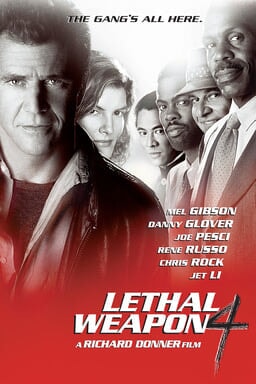
Having honed his craft in both television and low-budget features, RICHARD DONNER (Director/Producer) has gone on to direct some of the highest grossing films of both the '70s and '80s.

The New York City native moved to Los Angeles in 1958 and began directing commercials, industrial films and documentaries. He subsequently directed numerous episodes of such classic television series as "The Twilight Zone," "The Fugitive," "The Man From U.N.C.L.E.," "The Wild, Wild West," "The F.B.I.," and "Cannon," as well as the pilots for "Kojak" and "Bronk."

Donner acknowledges his direction of "The Omen" as the turning point in his career. The film, made on a budget of two million dollars, grossed $65 million, and spawned two sequels. The director's next film would prove to be another smash hit, as Donner made audiences believe that a man could fly with "Superman." Donner followed the visual spectacle of "Superman" with the intimate drama "Inside Moves," starring John Savage. Next came "The Toy," followed by "Ladyhawke" and "The Goonies," which he also produced with Steven Spielberg.

"Lethal Weapon," released by Warner Bros. in 1987, was another smash success for Donner, whose most recent box office hit was the Christmas comedy "Scrooged," starring Bill Murray.

Just one day after the completion of principal photography on "Lethal Weapon 2," Donner went behind the cameras again to direct an episode of the multi-part HBO series "Tales From the Crypt," which he also executive produced with Joel Silver, David Oiler, Walter Hill and Robert Zemeckis. In addition to his directorial credits, Donner served as Executive Producer on the Warner Bros. production of "The Lost Boys."


While many producers spend an entire career hoping for just one successful film, JOEL SILVER (Producer), in the past seven years, is responsible for five productions that have each grossed more than $100 million worldwide: "48 HRS.," "Commando," "Predator," "Lethal Weapon," and "Die Hard."

Silver's first film, a short entitled "Ten Pin Alley," was made during his studies at the New York University film school. Shortly after his graduation, Silver moved to Los Angeles. His first job found him as assistant to producer Lawrence Gordon. Within a few short years, he worked himself into the position of president of the motion picture division of Lawrence Gordon Productions.

His initial work with Gordon was in the development, marketing and production of the Burt Reynolds films "Hooper" and "The End," and "The Driver," written and directed by Walter Hill. Silver was the associate producer of Hill's next film, "The Warriors."

Silver's association with Walter Hill continued, as he and Lawrence Gordon produced the top-grossing "48 HRS.," in addition to Hill's "Streets of Fire" and "Brewster's Millions." He was also the producer of "Weird Science," written and directed by John Hughes.

"Commando" was the first film produced by Silver under his newly formed production company, Silver Pictures. He and Gordon produced "Jumpin' Jack Flash," then another hit starring Arnold Schwarzenegger -- "Predator" -- for Twentieth Century Fox. After returning from Mexican locations on "Predator," Silver and Richard Donner went into production on "Lethal Weapon," which Silver followed with "Action Jackson" and "Die Hard."

In addition to "Lethal Weapon 2," Silver is further represented in theatres this summer with his production of "Road House," starring Patrick Swayze. Silver, Richard Donner, David Giler, Walter Hill and Robert Zemeckis are also executive producers of the new HBO anthology series, "Tales From the Crypt." Silver is currently in production on the comedy-action-adventure "Ford Fairlane," starring Andrew Dice Clay for Twentieth Century Fox.


Co-Producer JENNIE LEW TUGEND began her association with Richard Donner during the post-production of "Ladyhawke." She had previously spent four years as Jerome Hellman's assistant, working on the development of "The Mosquito Coast," which Hellman produced for Warner Bros., and before that, worked with ICM in both New York and Los Angeles.

Lew Tugend has worked on the development, production and release of both "The Goonies" and "The Lost Boys," and served as the associate producer of "Lethal Weapon" and "Scrooged. "


STEVE PERRY (Co-Producer) has been involved in some of the most critically and financially successful films of the last two decades. As an assistant director, Perry's credits include "Casey's Shadow," "The Cheap Detective," "Modern Romance," "Close Encounters of the Third Kind," "1941," "The Mountain Men," and "Wrong is Right." He received two Directors Guild of America awards for his work on "Rocky" and "Ordinary People."

"Firefox," "Sudden Impact" and "Honkytonk Man" (all with Clint Eastwood) and "The Mean Season" saw Perry not only as assistant director, but unit production manager as well, and on "Lethal Weapon," Perry filled the positions of unit production manager and second unit director. He has served as the executive in charge of production on "Short Circuit," was associate producer of "Action Jackson" (for which he also directed second unit), the unit production manager on "Peggy Sue Got Married," and executive producer and second unit director on the Silver Pictures production of "Road House."


In addition to his script which continues the adventures of Riggs and Murtaugh in "Lethal Weapon 2," screenwriter JEFFREY BOAM is also responsible for another of the summer s most highly awaited screen returns -- that of Indiana Jones in "Indiana Jones and the Last Crusade."

The Rochester, New York native was raised in Sacramento, California, received an Arts degree from Sacramento State College and his Master's Degree in Theatre Arts at UCLA.

His very first screenplay was optioned by director Ulu Grosbard, and when the director was called in to take over directorial chores on "Straight Time," he brought Boam with him for script rewrites. Boam ultimately received screenplay credit, which he shared with Edward Bunker and Alvin Sargent.

Boam's next screenplay was an adaptation of the Stephen King novel "The Dead Zone," directed by David Cronenberg. His subsequent films include the Warner Bros. productions of "Innerspace," "The Lost Boys," and "Funny Farm."


One of the first members of the "Lethal Weapon" production team to be called back for "Lethal Weapon 2" was production designer J. MICHAEL RIVA. Riva was exposed to the motion picture industry as a child, as his father William was a production designer, and his mother, following in the footsteps of her mother Marlene Dietrich, was also an actress. Riva began his own career as a commercial photographer, gaining experience in production design on a number of low-budget features. As an art director, he worked on "I Never Promised You a Rose Garden," and "Brubaker," starring Robert Redford. Riva's work so impressed the star that when Redford went to direct his first feature, he asked Riva to serve as art director on the Academy Award-winning "Ordinary People."

Riva received his own Oscar nomination as the production designer of "The Color Purple." His other credits include "The Golden Child," "The Adventures of Buckaroo Banzai," "Bad Boys," "The Slugger's Wife," "Strangers Kiss," and two films for Richard Donner, "The Goonies" and "Scrooged." 1n 1986, Riva made his directorial debut with an episode of Steven Spielberg's "Amazing Stories."


Another integral member of the "Lethal Weapon" crew brought back for "Lethal 2" was director of photography STEPHEN GOLDBLATT. A native of South Africa, Goldblatt began his career as a still photographer for the London Sunday Times. He worked on numerous commercials and documentaries before photographing his first feature film, "Breaking Glass," a musical drama about the rise of a British new-wave singer. Since then his credits have included "Outland," "The Return of the Soldier," "The Hunger," "The Cotton Club," "Young Sherlock Holmes," and more recently., "Everybody's All-American." His next project is "Joe Versus the Volcano," written and directed by John Patrick Shanley for Warner Bros. release.


"Lethal Weapon 2" marks the fifth collaboration between Richard Donner and film editor STUART BAIRD. Baird's first project with Donner was "The Omen," and their association has continued through the films "Ladyhawke," "Lethal Weapon," and "Superman," for which the editor received an Academy Award nomination. Baird's other feature credits include "Altered States," "Revolution," "Beyond the Limit," "Valentino," "Five Days One Summer," and the film version of the rock opera "Tommy."


The musical score for "Lethal Weapon 2" is the combined effort of three of today's most exciting composers and musicians:


MICHAEL KAMEN's list of feature film credits -- in addition to the first "Lethal Weapon" -- includes Pink Floyd's "The Wall" (for which he composed the background score), "Angelo, My Love," "The Dead Zone," "Highlander," "Mona Lisa," "Die Hard," Terry Gilliam's "Brazil" and "The Adventures of Baron Munchausen," "Dead-Bang," "For Queen & Country," "Road House," and "Renegades."

Kamen has also written seven ballet scores, working with such international companies as The Joffrey Ballet and La Scala Opera Company. Among his television credits are the music for the "Mirror, Mirror" episode of "Amazing Stories" directed by Martin Scorsese, and two Emmy Awards for the movies-of-the-week "Christina's World" and "Liza's Pioneer Diary."


ERIC CLAPTON is undoubtedly one of the most influential and innovative musicians of rock history, with a unique blues-based guitar sound that has meant both recording and concert successes.

Clapton took up the guitar at age 15, drawing inspiration from such American blues artists as Robert Johnson, Blind Boy Fuller, Big Bill Broonzy, Blind Lemon Jefferson, Skip James and others. Within a few years he had evolved his own style, clearly demonstrated on The Yardbirds' 1965 album, Five Live Yardbirds, on which he made his recording debut. Clapton subsequently joined legendary British bluesman John Mayall, an association which yielded the groundbreaking album, Bluesbreakers. Touring with Mayall, Clapton attained "guitar hero" status, and in 1966 he left Mayall to form the innovative group Cream. With this band, Clapton enjoyed his first real commercial success and international recognition as rock's foremost guitar virtuoso. Cream recorded a string of rock classics, including "Sunshine of Your Love," "White Room," "Crossroads" and "Badge."

Clapton then formed the famed but short-lived group Blind Faith, which produced an album, then left shortly thereafter to play with John Lennon. He later worked with Delaney & Bonnie, recorded a successful solo LP, then founded Derek And The Dominos and cut the album Layla, which showcased Clapton in top form. The title track became another all-time classic for the singer/guitarist.

Clapton marked the years following Layla with a semi-retirement. Then, in 1973, at the urging of his friend Pete Townshend, Clapton agreed to appear at London's Rainbow Theatre in an enormously successful all-star concert.

Since then, Clapton has produced a series of albums which reflect the continuing development of an extraordinary artist, including 461 Ocean Boulevard, There's One In Every Crowd, No Reason To Cry, Slowhand, Backless, Another Ticket, Money and Cigarettes, Behind The Sun, and August. His next LP will feature guest performances by such artists as George Harrison and Robert Cray.

Clapton also co-composed the music for the first "Lethal Weapon."


DAVID SANBORN is one of the undisputed masters of conteporary jazz and pop, with several Grammy Awards to his credit and a string of highly popular recordings.

Sanborn began studying alto saxophone while still in grade school in his native St. Louis, Missouri. He started playing rhythm & blues gigs in downtown clubs where he would go to listen and sit in. He studied music theory more formally at Northwestern University and later at the University of Iowa. A visit to San Francisco during its 1967 "Summer of Love" resulted in Sanborn joining the Paul Butterfield Blues Band just as Butterfield was introducing brass into the group's sound. Sanborn remained with Butterfield over a four year period, contributing a much-acclaimed solo on the title cut of the band's In My Own Dream LP.

Following his stint with Butterfield, Sanborn recorded and toured with an extraordinary variety of established artists. He spent two years with Stevie Wonder and worked with such talents as Paul Simon, James Taylor, David Bowie. James Brown, The Eagles, Bruce Springsteen, Dan Fogelberg, Roger Waters and The Rolling Stones.

Sanborn's first solo LP, 1975's Taking Off, promptly marked him as a player of considerable vision and emotional range. his subsequent albums have included Sanborn, Promise Me The Moon, Heart to Heart, Hideaway, Voyeur, As We Speak, Backstreet, Straight To the Heart, Double Vision, A Change of Heart and Close-Up.

Sanborn hosted "The Jazz Show," his own weekly radio program for Westwood One, and currently hosts the weekly NBC-TV music program "Sunday Night."


© 1998 Warner Bros.